The SailJuice Winter Series: Britain’s Great Winter Handicap Challenge
For more than a decade and a half, the SailJuice Winter Series has given Britain’s dinghy sailors a compelling reason to keep racing through the darkest months of the year. What began in 2009 as the SailJuice Global Warm-Up, an attempt to bring the country’s fragmented winter handicap scene together, has developed into one of the most distinctive competitions in British sailing: a nationwide contest in which champions from very different classes meet on the same racecourse.
The idea is simple but ambitious. Instead of treating established winter fixtures as isolated meetings, the Series links them into a season-long championship. Sailors collect results across some of the biggest and most demanding handicap events in the country, racing through everything a British winter can produce—light airs, freezing rain, short days and hard, gusty breezes.
That combination of endurance and variety is central to the Series. A successful campaign calls for much more than one outstanding weekend. Competitors must perform at different venues, adapt to changing race formats and conditions, and make their results count against a fleet drawn from across the dinghy-racing spectrum.
One contest, many kinds of boat
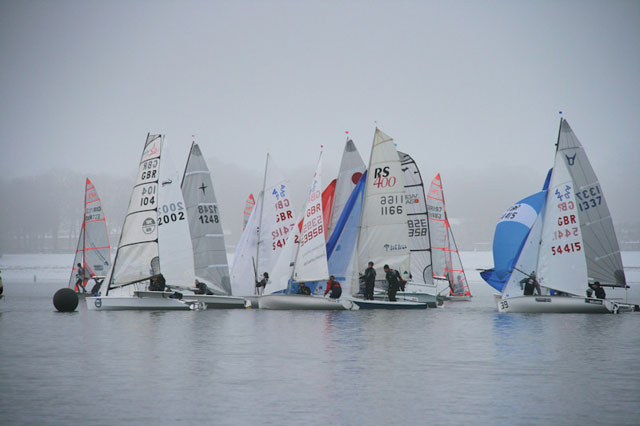
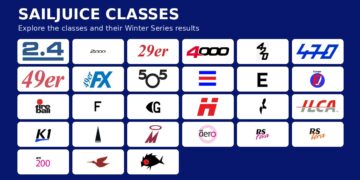
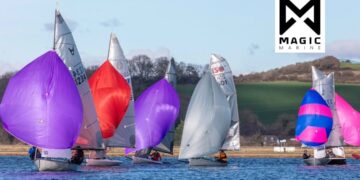
The defining character of the SailJuice Winter Series is its diversity. Singlehanders, hiking dinghies, trapeze boats, skiffs and traditional classes all compete within the same overall championship. In a typical season, close to 100 different types of boat may be represented, with around 1,000 sailors taking part across the constituent events.
The range can stretch from junior and traditional designs to some of the fastest development classes. That creates a contest unlike a conventional one-design championship. The first boat across the finish line is not necessarily the winner; success depends on sailing efficiently against the clock and making every second count after handicap correction.
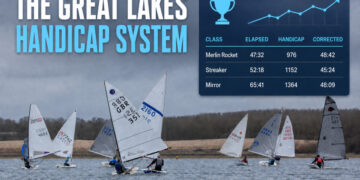
Fair racing between such different boats relies on the Great Lakes Handicap Group. Its handicap numbers are a variation of the RYA Portsmouth Yardstick system, refined using evidence from major winter events. The more frequently a class competes, the more useful data becomes available and the more accurately its number can be assessed. This practical, evidence-led approach has helped the Series welcome classes that might otherwise struggle to establish reliable handicaps.
It also produces one of the circuit’s greatest attractions: sailors can compare their performance with leading competitors from completely different disciplines. A Solo can challenge an Osprey, a Laser can take on a GP14, and a Musto Skiff can race for the same overall title as a Merlin Rocket.
The idea and the organisers
Professional sailing journalist and dinghy racer Andy Rice conceived the Series as a way of increasing participation in British dinghy racing during the off-season. Rice had already enjoyed success in the 470, 49er and International 14 and won the Bloody Mary in 2003. His experience as a competitor, writer and commentator helped give the new circuit both a sailor’s perspective and a strong media identity.
Rice co-organises the Series with Simon Lovesey of SailRacer. Lovesey brought a background in business, sales and marketing together with a conviction that technology could help move grassroots sailing from the analogue to the digital age. SailRacer’s results database, advance online entry, competitor communications, event websites and GPS tracking became fundamental parts of the circuit.
The partnership has proved complementary. Rice leads much of the editorial storytelling, producing previews and reports throughout the winter, while Lovesey’s technological, commercial and event-management expertise connects the individual fixtures into a coherent championship. Together with the host clubs, the Great Lakes Handicap Group, sponsors, volunteers and photographer Tim Olin, they have built the structure that allows the Series to operate nationally.
From GJW Direct to Seldén—and Navigators & General
The first SailJuice Winter Series took place in 2009/10, when Olly Turner and Richard Whitworth won the title in a Merlin Rocket. As the circuit grew, GJW Direct became the title sponsor, supporting a run of seasons in which the Series established itself as a central feature of the winter calendar. The GJW Direct name appeared on the championship from 2013/14 through 2017/18 and the marine insurer has continued to support individual events and initiatives, including coaching delivered by Simon Horsfield in 2024/25.
Seldén Mast took over as title sponsor for 2018/19. Its eight-season tenure ran through 2025/26 and included the difficult COVID period. Seldén’s support helped sustain the promotional work around the championship and maintain its visibility across the UK dinghy community. Alongside the title partnership, the Series developed category and event sponsorships covering areas such as youth, family, club and women’s rankings, photography, clothing, coaching and individual regattas.
For Season 18 in 2026/27, specialist marine insurer Navigators & General becomes the new title sponsor after first supporting the Series’ coaching programme in 2025/26. Announcing the partnership, Navigators & General described the championship’s extraordinary variety of classes and nationwide community as a natural fit for an insurer serving almost every kind of dinghy. Seldén’s title-sponsor chapter has closed, but the organisers have continued discussions about other ways for the spar maker to remain involved.
Although the name above the title has changed, the purpose has remained consistent: to strengthen grassroots dinghy racing, support the clubs that host the country’s major winter events and give sailors a meaningful championship when most class circuits are in hibernation.
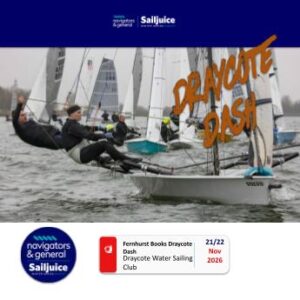
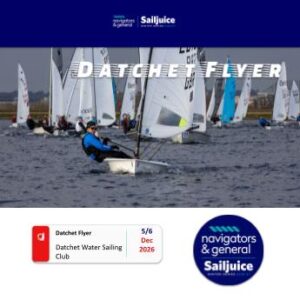
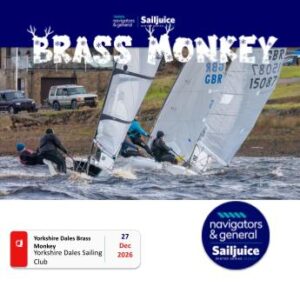
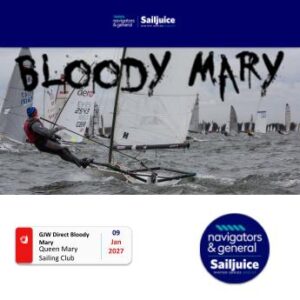
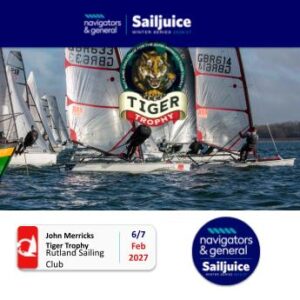
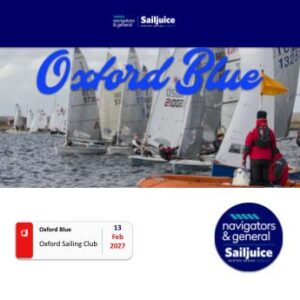
The modern Series is managed by SailRacer and typically runs from late November into February. Familiar fixtures have included the Draycote Dash, Datchet Flyer, Brass Monkey, Grafham Grand Prix, Bloody Mary, John Merricks Tiger Trophy and Oxford Blue, with other events joining the programme in different years. Together, they form a tour of some of Britain’s best-known inland sailing venues.
The circuit’s importance is not measured only by entry numbers. It creates a shared winter stage for clubs, classes and generations. National champions, world champions and Olympic medallists race alongside club competitors; youth sailors share the course with sailors who have accumulated decades of experience. Some classes incorporate individual Series meetings into their own championships, adding still more depth to the fleets and offering smaller associations a low-overhead way to maintain a winter programme.
Since 2014, the season has been celebrated with a prizegiving at the RYA Dinghy & Watersports Show. The ceremony has grown into a major gathering in its own right, presenting prizes not only to the overall champions but across age groups, boat types, clubs and other categories.
Innovation through the winter
From the outset, Rice and Lovesey treated the Series as a test bed for ideas that could benefit the wider sport. Advance online entry through SailRacer was initially resisted by some clubs, but it became standard practice and, before the pandemic, more than half the Series events regularly reached capacity in advance.
The Great Lakes handicaps were another decisive innovation. They were introduced because the organisers believed the standard numbers then available did not always deliver sufficiently fair racing across such a diverse fleet. The resulting data-led system regularly produces eight, nine or even ten different classes in an event’s top ten, one of the clearest measures of the Series’ competitive diversity.
GPS tracking is now used across the circuit, allowing spectators to follow racing live, competitors to replay their races and organisers to examine scoring queries. It also provides a coaching tool, enabling sailors to compare speed and tactical choices leg by leg. Tim Olin’s photography gives the Series another layer of visibility: thousands of branded and tagged photographs are distributed through club, class and social-media channels during a typical winter.
When COVID restrictions threatened organised sport, the Series adapted rather than disappear. Remote racing, online briefings and prizegiving, digital signing-on and online protest procedures helped keep the championship operating within the prevailing guidelines. The experience reinforced the value of the digital systems already developed around the circuit.
More recently, the organisers have used the Series to encourage older but serviceable boats back into competition. Specific rankings and, where appropriate, handicaps for older versions of established classes have shown that competitive winter racing need not depend on owning the newest equipment. The first Zhik Old Boats league in 2024/25 attracted craft ranging from early RS designs to a 66-year-old Norfolk Punt; Paul Young and Igor Bakowski won the overall trophy in an Enterprise.
Champions across the classes
The roll of honour shows just how open the Series has been. The inaugural Merlin Rocket victory was followed by Andy Peake’s Musto Skiff title in 2010/11. A Scorpion, Fireball, Solo, GP14, RS200, Laser, 2000, 505 and Osprey have all subsequently carried their sailors to the championship.
Certain achievements stand out. Simon Horsfield and Katie Burridge became the first team to win three consecutive titles, dominating the 2000 class campaigns of 2018/19, 2019/20 and 2020/21; Natalie Johnson also crewed during the third of those seasons. Their hat-trick remains the clearest example of sustained mastery across multiple winters.
Tom Gillard has built a different kind of record. After winning the 2012/13 Series in a Fireball with Simon Potts, he returned more than a decade later to win back-to-back titles with Rachael Gray—first in a Scorpion in 2024/25 and then in a Merlin Rocket in 2025/26. Those victories made Gillard the first helm to win the Series in three different classes and placed him alongside Horsfield as a three-time champion.
The Gray family name also runs prominently through the history. Peter Gray won the 2011/12 title with Rachael Rhodes in a Scorpion and returned to the top in 2022/23 with Geoff Edwards in an Osprey. Rachael Gray’s consecutive victories with Gillard added another chapter to that story.
Other seasons underline the breadth of talent required. Michael Sims won in a Solo, Alistair Goodwin in a Laser and Sam Pascoe in a Musto Skiff. Roger Gilbert and Ben McGrane succeeded in the high-performance 505, while Matt Mee and Emma Norris won in the hugely competitive RS200. Each champion found a different route to the same prize.
More than a results table
The Series has evolved beyond a simple collection of scores. Photography, race reports, video, GPS tracking and coaching have helped competitors and followers understand how races are won and lost. Every event is supported by preview and results coverage, with around two dozen press releases generated during a typical season. Tim Olin’s event photography has documented the fleet in conditions ranging from drifting calm to survival weather, while online coverage has allowed the wider sailing community to follow the contest throughout the winter.
Coaching has also become part of the modern programme. Three-time champion Simon Horsfield has shared practical observations from the racecourse, using pre-event briefings, boat-park advice, on-water video, GPS analysis and post-event debriefs to show sailors where gains can be made. GJW Direct supported the coaching in 2024/25 and Navigators & General took over that support in 2025/26. That emphasis matters: the Series celebrates the front of the fleet while also helping club sailors improve.
The scale of the operation is substantial. Figures in the 2025/26 sponsorship prospectus recorded 572 boats, around 1,000 sailors, 84 classes and 153 clubs, supported by 1,386 branded photographs, 23 press releases, 55 articles and more than 27,000 GPS-tracking views. Those numbers explain why the Series offers sponsors something unusual: sustained contact with a broad cross-section of the active UK dinghy market over four winter months, rather than exposure at a single class or weekend event.
Its appeal has even attracted interest beyond Britain, with organisers in other countries exploring how a similar multi-event handicap concept might work in their own racing communities. The reason is easy to understand. The SailJuice model gives established events a common narrative, encourages sailors to travel and keeps a broad range of classes active through the off-season.
A championship built for winter sailors
The SailJuice Winter Series has endured because it captures something essential about British dinghy racing. It rewards preparation, versatility and persistence. It values the host clubs and volunteers who make winter racing possible. Above all, it gives almost any dinghy sailor—with the right determination and enough warm clothing—the opportunity to compete in the same championship as some of the country’s best.
From the first Merlin Rocket victory in 2009/10 to another Merlin Rocket triumph in 2025/26, the Series completed a remarkable 17-season arc. With Navigators & General taking over the title partnership for Season 18, the boats, sponsors and venues continue to evolve, but the challenge remains the same: travel, adapt, race hard and prove who can master a British winter.
Roll of honour
| Season | Champions | Class |
|---|---|---|
| 2025/26 | Tom Gillard & Rachael Gray | Merlin Rocket |
| 2024/25 | Tom Gillard & Rachael Gray | Scorpion |
| 2023/24 | Sam Pascoe | Musto Skiff |
| 2022/23 | Peter Gray & Geoff Edwards | Osprey |
| 2021/22 | Roger Gilbert & Ben McGrane | 505 |
| 2020/21 | Simon Horsfield & Katie Burridge / Natalie Johnson | 2000 |
| 2019/20 | Simon Horsfield & Katie Burridge | 2000 |
| 2018/19 | Simon Horsfield & Katie Burridge | 2000 |
| 2017/18 | Alistair Goodwin | Laser |
| 2016/17 | Matt Mee & Emma Norris | RS200 |
| 2015/16 | Ian Dobson & Andy Tunnicliffe | GP14 |
| 2014/15 | Nick Craig & various crews | Merlin Rocket |
| 2013/14 | Michael Sims | Solo |
| 2012/13 | Tom Gillard & Simon Potts | Fireball |
| 2011/12 | Peter Gray & Rachael Rhodes | Scorpion |
| 2010/11 | Andy Peake | Musto Skiff |
| 2009/10 | Olly Turner & Richard Whitworth | Merlin Rocket |




Leave a Reply
Navigators & General SailJuice Winter Series, UK's premier winter handicap racing.