SailJuice Winter Series – Season-by-Season Summary
2009/10 — Olly Turner & Richard Whitworth, Merlin Rocket
The inaugural championship was held under its original name, the SailJuice Global Warm-Up, and linked four major winter fixtures: the Bloody Mary, Steve Nicholson Trophy, John Merricks Tiger Trophy and Hoo Freezer. A severe winter of ice, snow and gales made simply completing the no-discard series an achievement. Olly Turner demonstrated unusual versatility, crewing Richard Whitworth at three events and helming at another. Their ninth place in the Hoo Freezer practice race became decisive when Force 7 winds caused the main race to be cancelled, lifting Turner to the first Series title. Season report
2010/11 — Andy Peake, Musto Skiff
The second edition broadened the competition and confirmed that the multi-event handicap concept could work across radically different boats. Early leaders Matt Biggs and Ben Hollis put their Merlin Rocket at the top after Grafham and the Bloody Mary, but Andy Peake’s consistency in the much faster Musto Skiff ultimately secured the championship. It was the first Series victory by a singlehanded trapeze boat and the second different winning class in two seasons.
2011/12 — Peter Gray & Rachael Rhodes, Scorpion
By its third season the circuit had grown to five events, attracting 620 boats from 92 classes, an 18 per cent increase on the comparable previous programme. Four boats went into the Draycote Dash finale with a realistic chance of winning, but Peter Gray and Rachael Rhodes secured the title after taking second at the event. Their Scorpion defeated Ian Morgan’s Laser and the Fireball of Sam Mettam and Richard Anderton in a tense conclusion that also prompted discussion about match-racing tactics within handicap competition. Season report
2012/13 — Tom Gillard & Simon Potts, Fireball
Tom Gillard and Simon Potts took the fourth championship in their Fireball, adding another high-performance doublehanded class to the growing roll of honour. Their victory demonstrated the Series’ ability to reward a fast trapeze boat across varied winter conditions, rather than favouring one particular style of dinghy. Later in 2013 the same partnership became Fireball World Champions, underlining the standard of sailor the winter circuit was beginning to attract.
2013/14 — Michael Sims, Solo
The first season carrying the GJW Direct SailJuice Winter Series title was one of the largest and toughest yet. A wet and windy eight-event campaign attracted 835 boats from 95 classes. Michael Sims sailed his Solo to the narrowest of victories over Ben Schooling’s Musto Skiff; gusts of up to 35 knots at the final Tiger Trophy made Schooling’s attempt to regain the lead exceptionally difficult. The contrast between a conventional hiking singlehander and a high-performance trapeze boat captured the purpose of Great Lakes handicap racing. Season report
2014/15 — Nick Craig & various crews, Merlin Rocket
Nick Craig won two constituent events—the Datchet Flyer and Oxford Blue—and held off a late challenge from the faster boats to claim the overall title. He raced his Merlin Rocket with Alan Roberts, Oli Wells and Toby Lewis during the campaign. Light early events favoured slow- and medium-handicap boats before stronger winds brought Contenders and Fireballs into contention. Eight different classes filled the final top ten, split evenly between singlehanders and doublehanders and between hiking and trapeze boats. Season report
2015/16 — Ian Dobson & Andy Tunnicliffe, GP14
Ian Dobson and Andy Tunnicliffe added the GP14 to the list of championship-winning classes. Their success came from the adaptable, all-round performance needed across a programme of established fixtures including the Draycote Dash, Datchet Flyer, Brass Monkey, Oxford Blue, Bloody Mary, Steve Nicholson Trophy, Tiger Trophy and a rescheduled Grafham Grand Prix. It was another victory for a traditional hiking doublehander against a fleet containing much newer and faster designs.
2016/17 — Matt Mee & Emma Norris, RS200
Matt Mee and Emma Norris won Season Eight in their RS200. The victory was significant for one of Britain’s strongest modern one-design classes: the RS200’s combination of tactical upwind sailing and asymmetric-spinnaker speed proved effective across the winter’s varied race formats. Their title became the eighth different class to win in the first eight seasons, illustrating how widely the championship honours were being shared.
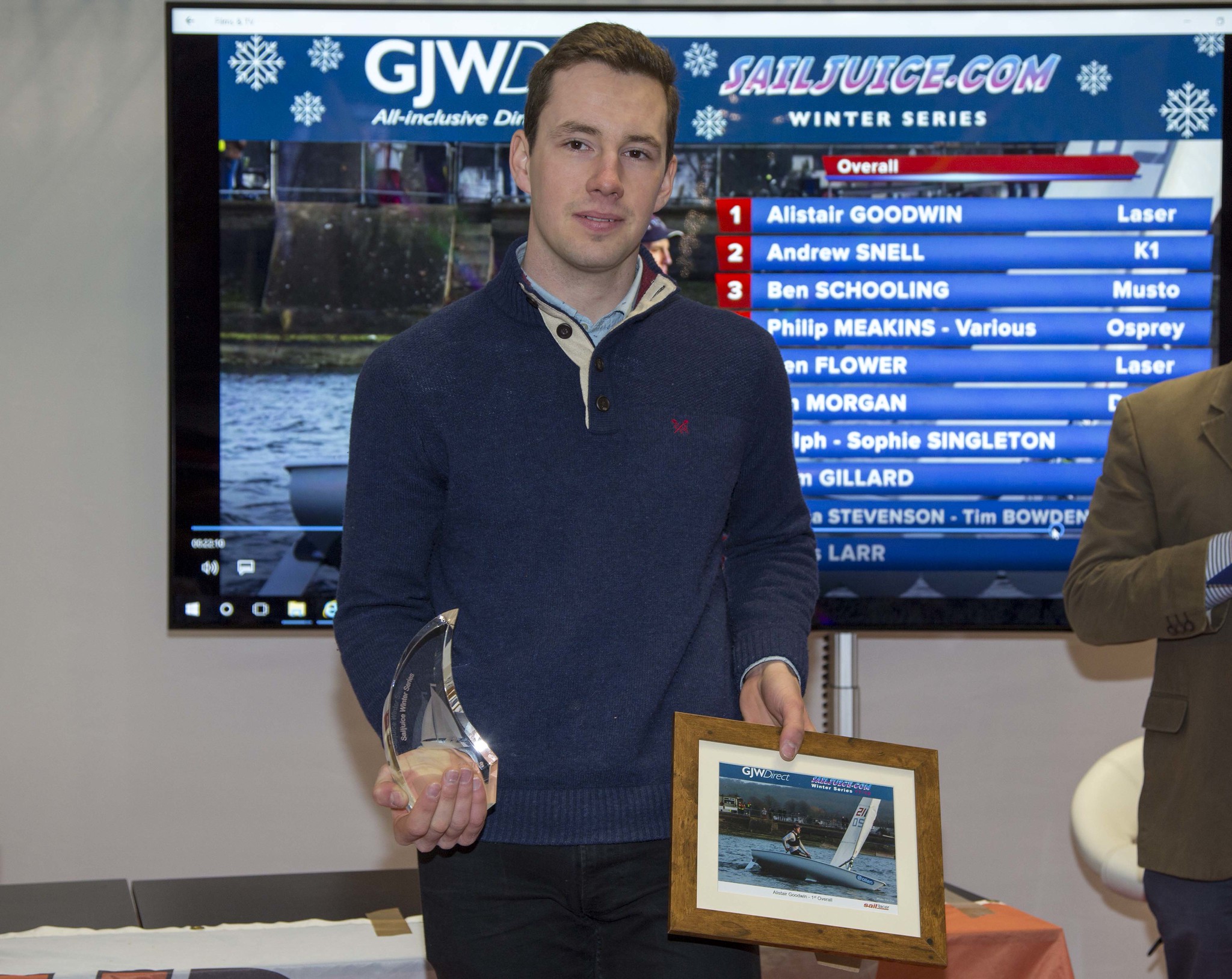
2017/18 — Alistair Goodwin, Laser
The ninth edition produced the closest contest in Series history to that point. After seven events, the title came down to the final race at the Oxford Blue, where Alistair Goodwin edged out long-time leader Andrew Snell in a K1. Goodwin became the first Laser sailor to win the Series, with Musto Skiff sailor Ben Schooling third. The season also experimented with GPS-based dynamic handicap and speed rankings, while the cancellation of the Bloody Mary led to the King George Gallop joining the programme. Season report
2018/19 — Simon Horsfield & Katie Burridge, 2000
The tenth-anniversary season opened the Seldén title-sponsorship era and drew nearly 600 entries, around 1,000 sailors, 92 classes and competitors from more than 300 clubs. Simon Horsfield and Katie Burridge compiled an outstanding series in their 2000, finishing ahead of Peter Gray’s National 18 team. Nine different classes appeared in the top ten, including the Norfolk Punt of Colin and Oly Murray. The number of Series qualifiers rose by 47 per cent to 50, indicating that more sailors were committing to the full circuit. Season report
2019/20 — Simon Horsfield & Katie Burridge, 2000
Horsfield and Burridge successfully defended the championship, becoming the first team to win two consecutive SailJuice titles. Their 2000 remained effective across a winter that included an exceptionally windy Bloody Mary, where gusts exceeded 30 knots. The season confirmed that their first victory was no anniversary-year one-off: preparation, consistency and precise mixed-fleet tactics had made them the benchmark partnership.
2020/21 — Simon Horsfield & Katie Burridge / Natalie Johnson, 2000
The COVID-affected season required a shortened and adapted programme, with online briefings, remote processes and other measures used to keep the Series operating. Horsfield and Burridge, assisted by stand-in crew Natalie Johnson, won for a third consecutive year—an unprecedented hat-trick. Their best three scores from four events totalled 12.4 points, holding off Luke Fisher’s RS Vareo on 15.7, with Patrick Overs third in a Solo. Season report
2021/22 — Roger Gilbert & Ben McGrane, 505
The return toward a fuller programme was still disrupted, with the Brass Monkey, Grafham Grand Prix and Bloody Mary cancelled. Roger Gilbert and Ben McGrane nevertheless dominated the events that survived. They won the opening 87-boat Draycote Dash and the Tiger Trophy, also scoring strongly at Datchet and the King George Gallop, to finish on just 5.6 weighted points. Luke Fisher’s RS Vareo was runner-up and Ben Flower’s ILCA 7 third. Overall results
2022/23 — Peter Gray & Geoff Edwards, Osprey
Peter Gray returned to the top eleven years after his Scorpion victory, this time sailing an Osprey with Geoff Edwards. Racing a class boat loaned by the Osprey association, they prevailed in the closest finish of the Series’ first 14 years. Ben Flower was runner-up in an ILCA 7, while Joe Scurrah’s consistently sailed RS Aero 7 took third. The result showed both the value of class-association support and Gray’s versatility across different doublehanded boats. Season report
2023/24 — Sam Pascoe, Musto Skiff
Sam Pascoe produced one of the most emphatic championship performances in Series history. In a winter repeatedly shaped by strong winds, he used the speed and athletic demands of the Musto Skiff to great effect, winning the Draycote Dash and an extreme Datchet Flyer on the way to the overall crown. Pascoe later credited the campaign with making him race-ready for an unbeaten 2024 Musto Skiff season that included the World Championship. The Series subsequently began exploring coaching and special handicaps to encourage older boats. Season review
2024/25 — Tom Gillard & Rachael Gray, Scorpion
Named storms repeatedly altered a nine-event season: the opening Draycote Dash was postponed by Storm Bert and eventually sailed in January, while much of the winter proved unexpectedly light. Tom Gillard and Rachael Gray’s Scorpion excelled in those predominantly hiking conditions, winning with 13.66 points ahead of Simon Hawkes’ K1 and the Snipe of Matthew Wolstenholme and Lloyd Roberts. The first Zhik Old Boats league encouraged boats at least 20 years old back onto the water, while Simon Horsfield delivered GJW Direct-supported coaching. Season report
2025/26 — Tom Gillard & Rachael Gray, Merlin Rocket
Gillard and Gray defended their winter crown after switching from the Scorpion to a Merlin Rocket. They began with consecutive victories at the Draycote Dash and Datchet Flyer; Gillard then made it three from three at the Polar Chase with Arran Holman standing in as crew. The partnership continued its winning run at the Tiger Trophy and secured the overall championship across the eight-event season. Their success gave Gillard a third SailJuice title in a third different class—Fireball, Scorpion and Merlin Rocket—while Gray became a back-to-back champion in two different boats. Navigators & General supported Simon Horsfield’s expanded coaching programme, and Seldén completed its eighth and final season as title sponsor. Series archive
The story across 17 seasons
Across its first 17 editions, the Series evolved from a four-event experiment into a major national winter championship. The winners span traditional hiking dinghies, singlehanders, asymmetric classes, trapeze boats and high-performance designs. Only Simon Horsfield and Katie Burridge have won three successive editions, while Tom Gillard became the first helm to win in three different classes. The variety of champions remains the strongest evidence that the central idea—bringing Britain’s winter classics together under carefully managed handicap racing—has endured.



Leave a Reply
Navigators & General SailJuice Winter Series, UK's premier winter handicap racing.